
Our Work
.
We Won’t End Gender-Based Violence Without Disability Justice
-
English
-
Français
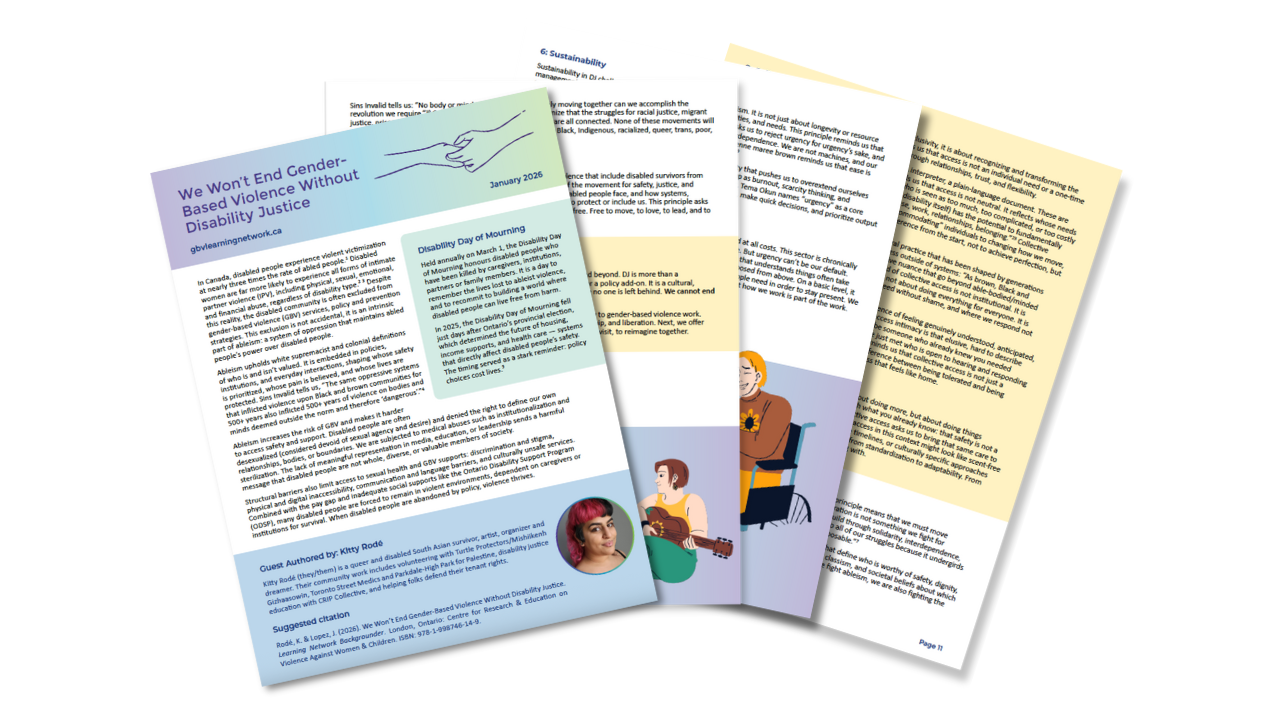
January 2026
Click here to access the PDF
Click here to access the companion infographic
We Won’t End Gender-Based Violence Without Disability Justice
In Canada, disabled people experience violent victimization at nearly three times the rate of abled people. [1] Disabled women are far more likely to experience all forms of intimate partner violence (IPV), including physical, sexual, emotional, and financial abuse, regardless of disability type. [2–3] Despite this reality, the disabled community is often excluded from gender-based violence (GBV) services, policy and prevention strategies. This exclusion is not accidental, it is an intrinsic part of ableism: a system of oppression that maintains abled people’s power over disabled people.
Ableism upholds white supremacist and colonial definitions of who is and isn’t valued. It is embedded in policies, institutions, and everyday interactions, shaping whose safety is prioritized, whose pain is believed, and whose lives are protected. Sins Invalid tells us, “The same oppressive systems that inflicted violence upon Black and brown communities for 500+ years also inflicted 500+ years of violence on bodies and minds deemed outside the norm and therefore ‘dangerous’.” [4]
Ableism increases the risk of GBV and makes it harder to access safety and support. Disabled people are often desexualized (considered devoid of sexual agency and desire) and denied the right to define our own relationships, bodies, or boundaries. We are subjected to medical abuses such as institutionalization and sterilization. The lack of meaningful representation in media, education, or leadership sends a harmful message that disabled people are not whole, diverse, or valuable members of society.
Structural barriers also limit access to sexual health and GBV supports: discrimination and stigma, physical and digital inaccessibility, communication and language barriers, and culturally unsafe services. Combined with the pay gap and inadequate social supports like the Ontario Disability Support Program (ODSP), many disabled people are forced to remain in violent environments, dependent on caregivers or institutions for survival. When disabled people are abandoned by policy, violence thrives.
Disability Day of Mourning
Held annually on March 1, the Disability Day of Mourning honours disabled people who have been killed by caregivers, institutions, partners or family members. It is a day to remember the lives lost to ableist violence, and to recommit to building a world where disabled people can live free from harm.
In 2025, the Disability Day of Mourning fell just days after Ontario’s provincial election, which determined the future of housing, income supports, and health care — systems that directly affect disabled people’s safety. The timing served as a stark reminder: policy choices cost lives. [5]
Suggested citation
Rodé, K. & Lopez, J. (2026). We Won’t End Gender-Based Violence Without Disability Justice. Learning Network Backgrounder. London, Ontario: Centre for Research & Education on Violence Against Women & Children. ISBN: 978-1-998746-14-9.
This violence has never gone unanswered. As society consistently fails disabled people, disabled community has had to actively resist GBV largely on our own: building care networks and safety plans, leading research, shaping legislation, and demanding systemic change. Organizations like Disability Alliance BC, established in 1977; The Disabled Women’s Network (DAWN) Canada, which traces its roots back to 1985; and the Disability Justice Network of Ontario (DJNO) launched in 2018, are among those leading this resistance. The GBV sector is already being strengthened by disabled leaders, organizers, researchers, and survivors — it is time for the sector to look beyond inclusion and toward liberation.
This Backgrounder focuses on disabled wisdom and innovation, not as mere inspiration, but as essential infrastructure for justice work. Disability Justice (DJ) is a movement and a framework that positions disability as a political and collective experience shaped by systems of oppression and generations of resistance. DJ calls us to reimagine access, care, safety, and liberation. It centers the leadership and wisdom of those most impacted and offers principles that can transform how we understand — and respond to — violence.
Resources
- My Body Doesn’t Oppress Me, Society Does https://youtu.be/7r0MiGWQY2g
- The Unfit in Canada: A History of Disability Rights and Justice https://www.djno.ca/dj-history
- Addressing Sexual Violence and Promoting the Sexual Rights of Women Labelled with Intellectual Disabilities https://www.gbvlearningnetwork.ca/our-work/issuebased_ newsletters/issue-41/index.html
A Call to Re-Envision: Crip Wisdom
Despite what stereotypes and stigma might lead you to believe, disabled people are not helpless. To survive centuries of oppression we have had to collaborate and innovate, developing what we call “crip wisdom”.
Crip wisdom is sharing freezer packs, heating pads and pain meds. Crip wisdom is masking during an ongoing pandemic. Crip wisdom is learning how to build DIY air conditioning and air filtration for the next heat wave or wildfire. Crip wisdom is calling friends instead of the cops. Crip wisdom is “we keep each other safe”.
Crip wisdom holds our strategies of survival, resistance, and collective care. Crip wisdom enhances all fights for justice, benefiting everyone. Disability Justice emerges from crip wisdom.
A Note on Language
“Crip” is a term derived from the slur “cripple”. Some disabled people reclaim “crip” as a source of power, self love and connection to disabled community.
What is Disability Justice?
DJ is a movement and a framework that examines how disability and ableism connect to all forms of oppression. It centers the lives and leadership of disabled Black, Indigenous and other people of colour (POC), as well as disabled queer, trans and Two-Spirit people with the understanding that our liberation will liberate the bodies and minds of all people. As Aurora Levins Morales writes, “What our bodies require in order to thrive, is what the world requires.” [6] DJ moves us towards community care, transformed systems, and interdependence over independence, all of which are essential for ending GBV.
DJ was named in 2005 by the Disability Justice Collective, which included disabled activists Patty Berne, Mia Mingus, Stacey Milbern, Leroy F. Moore Jr., and Eli Clare. It emerged as a response to the exclusionary, racist and single-issue approach of the Disability Rights Movement in the U.S., which centered white leaders and mobililty impairment, further marginalizing other disabilities and intersecting identities such as race, gender, sexuality, age and immigration status.
The DJ framework is built on The 10 Principles of Disability Justice developed by Patty Berne and Sins Invalid, a movement building and performance arts project. These guiding principles are essential to how we “get free,” shifting power away from systems of oppression such as white supremacy, capitalism, and the medical-industrial complex.
Resources
- The 10 Principles of Disability Justice https://sinsinvalid.org/10-principles-of-disability-justice/
- What is Disability Justice? https://briarpatchmagazine.com/articles/view/what-is-disability-justice
Disability Justice and GBV Work
The 10 Principles of DJ offer a path towards transforming how we understand and respond to harm. Moving from theory to practice means reshaping the foundations of how support is offered, who is centered, and what we mean by safety. As explained by Mia Mingus, “We don’t want to simply join the ranks of the privileged; we want to dismantle those ranks and the systems that maintain them.” [7]
It is not enough for the GBV sector to simply expand access to “also consider” disabled people. We must fundamentally re-envision the work itself and transform how we structure supports and advocacy. In the following section, we explore each of the 10 Principles and how they can inform GBV work across the sector.
1: Intersectionality
Intersectionality is an analytical framework developed by Kimberlé Crenshaw to describe the experiences of Black women who were excluded from both feminist and anti-racist movements. DJ follows Crenshaw’s work in recognizing that discrimination does not occur in discrete categories: ableism is entwined with white supremacy, capitalism and patriarchal violence. DJ invites us to examine how intersecting systems of oppression affect those marginalized by race, gender, ability, class, sexuality, age, religion, and immigration status. Our perspectives are never shaped by one identity alone, and neither is systemic violence. Ableism amplifies other forms of oppression, such as misogyny, racism, homophobia and transphobia, resulting in disproportionately high rates of GBV against disabled women, disabled people of colour, and disabled 2SLGBTQIA+ people.
The intersection of anti-Blackness, anti-Indigeneity, and ableism results in increased rates and severity of police violence against disabled Black and Indigenous people. A staggering number of disabled Black and Indigenous people across Canada are killed by police during mental health crises: Rodney Levi, D'Andre Campbell, Regis Korchinski-Paquet, Nicholas Nembhard, and too many others. When we apply an intersectional lens, we can see why interventions that do not involve the police are so crucial. For disabled people of colour, police interactions can be fatal. Intersectionality helps us understand why non-carceral responses to harm are not just ideal, they are absolutely necessary.
Oppression also disables people. As Imani Barbarin says, “Every form of marginalization leads to disability”. [8] Racist violence is disabling. GBV is disabling. Poverty is disabling. Intersectionality widens our understanding of GBV and how it connects to systemic violence such as racism, ableism, poverty, housing insecurity, environmental injustice, and more.
In Practice: GBV & intersectionality
In GBV work, we must understand how oppression shapes people’s lives and experiences of GBV. This includes recognizing how intersections of identity and oppression affect how we collect data, assess risk, provide support and build safety plans.
Access to justice is rooted in Canada’s colonial history and present-day social, political and legal structures. Benjamin Vandorpe writes, “Access to justice does not only apply to the Western legal system […] Justice spans also to healthcare, housing, personal safety, food security, and community (non-inclusive).” [9] Applying an intersectional lens in GBV work means more than naming multiple identities; it means transforming the existing systems that create risk and limit access to support.
Resources
- Putting Intersectionality into Action https://www.youtube.com/watch?v=aOmm3RStblI
- What is Transformative Justice? https://www.youtube.com/watch?v=U-_BOFz5TXo
- Intersections of Disability Justice and Transformative Justice https://www.youtube.com/ watch?v=8dKystkbHKQ
2: Leadership of those most impacted
We have a saying, “Nothing about us without us”. Meaning that no solution should be enacted without the full and direct participation of the people it will impact most. DJ prompts us to center, uplift, listen to, read and follow those who are directly affected by the violence we seek to dismantle. Following disabled leadership also disrupts “saviour” narratives that position us as passive or helpless victims who can only receive support from abled people, rather than be the ones who shape and provide that care.
In Practice: GBV & leadership of those most impacted
In GBV work, this means learning from and being accountable to disabled survivors, advocates, and organizers. This could look like hiring disabled people in leadership and training roles, developing peer support models and communities of practice led by disabled survivors, and allying with organizations that are disability-led and investing in community-based research, education, policy and advocacy that keeps disabled voices at the forefront. At the most basic level, do your disabled coworkers, clients, and community members have what they need to thrive and fully participate?
3: Anti-capitalist politic
Capitalism is an oppressive system that reduces people to profit-generating units, accumulating wealth for a white ruling class at the expense of everyone else. Capitalism is inherently ableist, as it forces us to devalue and abandon anyone unable to generate profit. Capitalist policies drive housing insecurity, deepen pay gaps and undermine social supports, pushing disabled people closer to violence, poverty, and death. DJ invites us to resist and dismantle these capitalist ideals.
Disabled people developed crip wisdom to survive under capitalism. Sins Invalid points out that disabled peoples’ “non-conforming” bodies and minds inherently resist capitalism because “our worth is not dependent on what and how much we can produce.” [10] Our existence allows us to center the inherent worth of all beings, regardless of what an individual may produce or earn. By valuing co-creation, care work, reciprocity and mutual aid, we divest from capitalist and colonial authority.
In Practice: GBV & anti-capitalist politic
Adopting an anti-capitalist politic is vital to ensure that GBV work is not abandoning those who have been relegated to society’s margins, or replicating these systems of marginalization. The GBV sector can work in service of anti-capitalism by ensuring equitable access to supports and resources.
In the workplace, we can pay disabled people fairly and recognize that access work is not separate from the “real work”. While accessibility includes physical accommodations like ramps and scent-free spaces, it also requires embracing different working styles, flexible schedules, and access needs as part of organizational norms. Resisting capitalism means building systems of care that center people over output, and making sure that safety is not reserved for those who can meet institutional expectations.
Resources
- Disability justice movements: history and practice https://tempestmag.org/2023/06/ disability-justice-movements-history-and-practice
- Painting the Ocean & the Sky: The Language of Nuance and Purpose in our Non-Carceral Community Crisis Response https://www.interruptingcriminalization.com/resources-all/ ocean-sky
4: Commitment to cross-movement organizing
Disability Justice is not a silo. It is deeply connected to racial justice, housing justice, labour rights, prison abolition, climate justice, the fight against colonialism, and all the ways we build movements to resist oppression. Disabled people have always been part of broader struggles for liberation. DJ reminds us that true collaboration also means holding aligned movements accountable for their own ableism.
One urgent example of this interconnectedness is Medical Assistance in Dying (MAID) — a process that allows disabled people in Canada to access assisted death. In Ontario, nearly half of those approved under MAID’s “Track 2” (which does not require a terminal illness) reported housing instability. [11] Many disabled people are choosing death because ableism makes life unlivable. As TVNDY (Toujours Vivant – Not Dead Yet) argues, this is not about autonomy; it is about abandonment. [12] The expansion of MAID without corresponding investments in housing, income, and care is social murder (and entirely avoidable) — it exposes how our society would rather kill disabled people than support us.
Housing is a DJ issue. Disabled people are overrepresented in institutions, face higher rates of homelessness, and are often denied accessible or affordable housing. [13] In Ontario, people receiving assistance through the Ontario Disability Support Program (ODSP) can have their benefits reduced or cut off if they marry or live with a partner, because their spouse’s income and assets are counted in eligibility assessments. [14] This policy forces many disabled people into financial dependence on our partners, limiting autonomy and increasing vulnerability to abuse. Organizations like Disability Without Poverty, the ODSP Action Coalition, and Parkdale Housing Justice Network have long drawn these connections between inadequate support and increased risk.
DJ is also deeply tied to labour rights, particularly when it comes to care work. The JUST CARE Toolkit from the Disability Justice Network of Ontario (DJNO) Prison Project highlights how disabled people and care workers alike are navigating systems that are exploitative, unsafe, and often invisibilized. Care work is deeply racialized and gendered, and DJ calls for collective transformation in how we value and structure care.
The criminal legal system is another structure where violence intersects. Disabled people, especially those experiencing mental distress, are often criminalized rather than supported. The DJNO Prison Project reminds us that for many disabled people — particularly Black, Indigenous, trans and queer people — interactions with police can be deadly. Sins Invalid, in their statement on police violence, writes:
“We do not see training as a viable solution, since it leaves intact the fundamental belief of the police that their purpose is to ‘control the situation.’ As people with disabilities, our bodies and minds are not controllable and cannot always comply — this must be understood. Our bodies and minds are not criminal. We are unique and we celebrate our complexities.” [15]
Cross-movement organising extends to climate justice, with clear links between colonial violence on the land and on Indigenous communities. We see the disabling effects of colonial violence in Asubpeeschoseewagong (Grassy Narrows) First Nation in Ontario. Between 1962-1970 the Dryden paper mill contaminated the English- Wabigoon River system with mercury, poisoning the water and fish. Mercury poisoning continues to impact generations of Indigenous people in Grassy Narrows and neighbouring Wabaseemoong (Whitedog) First Nation, causing severe health impacts and disability. [16] As Sins Invalid writes: “We must address not just health, not just respect for bodily autonomy, but also the fight for justice for all oppressed people and the earth itself.” [17]
We are also living through global, mass-disabling events such as COVID-19 and multiple genocides including Palestine and Sudan. Both reveal large-scale failures of care, public health, and international justice. DJ frameworks recognize that disability does not occur in isolation, but emerges from collective traumas and systemic neglect. Justice for disabled people must also mean justice for the land, for migrants, for colonized people, and for future generations.
In Practice: GBV & Commitment to cross-movement organizing
For GBV practitioners, the cross movement organizing principle is a call to expand the boundaries of our work. GBV is compounded by housing insecurity, poverty, incarceration, environmental racism, barriers to accessing care and more. When survivors have access to safe housing, livable income, and community support, they have more options, autonomy, and resources to navigate safety on their own terms. When we partner across movements — housing, income justice, disability rights, abolition, climate justice, and others — we reduce the risk of violence and increase the conditions for safety. This might look like supporting tenant organizing, advocating for stronger income supports, or challenging ableism within our own organizations. Cross-movement work is not a distraction from GBV, it is one of the most powerful tools we have to prevent and respond to it.
5: Recognizing wholeness
DJ teaches us that disabled people are not broken, lacking, or in need of fixing: we are whole. Our lives are not defined by what we lack, what we struggle with, or what systems fail to provide. Rather, our lives are complex, valuable, and filled with meaning — not despite disability, but within and through it.
Mia Mingus writes, “I was forced to put on my painful brace. A brace that I didn’t need to be whole, but others needed me to wear so that I could be “the right kind of disabled child”. One who they needed to be seen as trying to be as abled as possible, trying to fix myself and my walk and my body to be something other than I was. Something other than I am.” [18]
Mingus’s reflection speaks to a broader societal pattern — one where disabled people are expected to appear as though they are trying to “improve” in order to be seen as worthy of care. The idea that support must be earned through compliance or the performance of progress underlies many forms of ableist violence and neglect. It is deeply embedded in medical systems, social services, and even GBV supports. This shows up in language that labels survivors as “non-compliant” or “difficult” when we decline certain supports, or in policies that require proof of impairment to access accommodations. It assumes that disability is only legitimate if it is tragic, fixable, or documented.
Recognizing wholeness rejects the idea that value is tied to productivity, conformity, or the ability to appear “normal.” It insists that disabled people are experts in our own lives, and that care should be built around dignity and trust, not compliance or control.
In Practice: GBV & recognizing wholeness
In GBV work, recognizing wholeness means rejecting the impulse to fix, cure, or correct. It means offering support based on what a person says they need — not what a system assumes they should want. Disabled survivors are the experts of our own experience. Practitioners can hold space for the fullness of who we are, beyond diagnostic labels or trauma narratives. This also means designing services that reflect the multidimensional realities of disabled people — as parents, partners, youth, elders, newcomers, queer and trans people, and people with intersecting identities.
6: Sustainability
Sustainability in DJ challenges the pace and priorities of capitalism. It is not just about longevity or resource management — it’s about honouring our diverse bodies, capacities, and needs. This principle reminds us that sustainability begins with care for ourselves and each other. It asks us to reject urgency for urgency’s sake, and to build movements that last by centering care, pacing, and interdependence. We are not machines, and our organizing cannot mirror the systems we are trying to undo. adrienne maree brown reminds us that ease is natural: “What is easy is sustainable. Birds coast when they can.” [19]
DJ invites us to slow down. To resist the culture of hyperproductivity that pushes us to overextend ourselves in the name of efficiency or progress. In our movements, it shows up as burnout, scarcity thinking, and crisis response cycles that leave no room for reflection, grief, or rest. Tema Okun names “urgency” as a core characteristic of white supremacy culture — a pressure to move fast, make quick decisions, and prioritize output over people. [20]
In Practice: GBV & sustainability
In GBV work, sustainability means resisting the pressure to push forward at all costs. This sector is chronically underfunded and overworked, often operating in permanent crisis mode. But urgency can’t be our default. Sustainability means developing realistic work plans. It means leadership that understands things often take longer than expected. It means timelines shaped in collaboration, not imposed from above. On a basic level, it means offering food at meetings, quiet places to rest, and asking what people need in order to stay present. We cannot dismantle violence in ways that reproduce harm. DJ reminds us that how we work is part of the work.
7: Commitment to cross-disability solidarity
DJ means there is no disability hierarchy. It calls us to resist the tendency to prioritize one kind of access over another, or to only center support for those whose needs are most visible or most convenient to meet. It is a call to remember and protect each other.
In her essay Wherever You Are Is Where I Want To Be, Mia Mingus writes about crip solidarity as our refusal to abandon each other across differences in access, communication, and embodiment. She describes a love that is political and practical — showing up for each other not only in the ways we are familiar with, but in the ways others need. [21] This kind of solidarity demands emotional maturity, flexibility, and a commitment to connection that isn’t built on performance or convenience.
Cross-disability solidarity means advocating for policies and practices that support all disabled people — whether we use wheelchairs, screen readers, interpreters, medication, service animals, rest breaks, stim toys, flexible participation, or simply need others to move at a slower pace. It means recognizing that access isn’t a checklist, it’s a relationship with self and others that is built on trust, consent, and care.
DJ explicitly includes mental health issues, trauma, and neurodivergence. This means recognizing that PTSD, complex PTSD, depression, anxiety, brain injuries, sensory processing differences, and cognitive disabilities are all part of disability. DJ pushes back against the medical model, which often isolates and pathologizes these experiences, and instead embraces a political, cultural, and relational model of disability. Within this framework, trauma is not just a personal diagnosis, it is a response to systemic harm. [22] Survivors of GBV often live with trauma-related disabilities, and they deserve access and care that reflects the full range of how disability is experienced.
Mia Mingus reminds us that disability justice requires us to imagine new ways of being in relationship — ways that hold space for complexity, interdependence, and the emotional labour of care. She writes: “We will find other ways (create our own ways) and talk liberation and access and interdependency with our comrades. We will weave need into our relationships like golden, shimmering glimmers of hope — opportunities to build deeper, more whole and practice what our world could look like.” [21]
In Practice: GBV & commitment to cross-disability solidarity
In GBV work, this principle reminds us that access must be expansive, responsive, and holistic. It is not enough to provide one kind of support and assume it works for everyone. One survivor might need plain language and extended processing time. Another might need scent-free space and flexible lighting. Another might need support workers, extra time, or accessible tech. Cross-disability solidarity invites us to expect difference and to design our spaces and services with that difference in mind. In doing so, we create environments where more people can participate, heal, and lead, and where no one gets left behind.
8: Interdependence
DJ rejects the capitalist ideal of hyper-independence — that each person is solely responsible for their achievements and failures, and that empathy is a weakness. DJ is rooted in shared responsibility and collective care. It reminds us that all people depend on one another, and that interdependence is not something to be ashamed of, but rather, is something to build, nourish, and protect. In fact, networks of care and mutual aid can meet our needs more directly than the often-inadequate systems set up for us. By caring for each other, we reduce our dependency on waged labour and divest from capitalist and colonial authority (see 3: Anti– capitalist politic).
Interdependence means building relationships rooted in trust, reciprocity, and shared responsibility, not control, compliance, or hierarchy. It means helping disabled people maintain spaces where we can openly share our experiences and support each other. And it means creating systems of care that are flexible, community-led, and sustainable.
In Practice: GBV & interdependence
In GBV work, interdependence offers a pathway out of isolation and into community-based care, connection, and healing. It reminds us that survivors do not just need services, we need people. Friends, family, neighbours, colleagues and community members who are prepared to show up with commitment and care. Supporting interdependence means helping survivors build and maintain these networks. It means recognizing that safety lives not in systems, but in relationships.
One practical tool that can support this work is “pod mapping”, developed by Mia Mingus for the Bay Area Transformative Justice Collective (BATJC). Pod mapping invites us to identify people in our lives — not professionals, but chosen community — who we can turn to in moments of harm, crisis, or need. These “pods” form networks of mutual care and accountability that do not rely on carceral systems, and can guide survivors in naming and nurturing safe, trusting relationships.
For disabled survivors in particular, this work is vital. Many have been isolated not only by abusers, but by systems that failed to recognize our needs, dismissed our access barriers, and taught us that relying on others is shameful. Some of us may have withdrawn from connection as a way to protect ourselves from harm or surveillance. DJ reminds us that healing is relational — that care does not have to come from institutions, but can emerge through mutual aid, chosen family, and peer support rooted in consent and trust. When GBV service providers support disabled survivors in building and sustaining our own networks of care rather than insisting on professionalized or institutional responses, they are honoring the principle of interdependence. They are saying: you do not have to navigate violence, life and disability alone, and you do not have to do it on someone else’s terms.
Resource
- Pods: The Building Blocks of Transformative Justice & Collective Care https://www.soiltjp. org/our-work/resources/pods
9: Collective access
Collective access is not just about physical access, or inclusivity, it is about recognizing and transforming the inequalities that exist between us. This principle teaches us that access is not an individual need or a one-time fix. It is something we create together, in community, through relationships, trust, and flexibility.
Too often, access is framed as a checklist: a ramp, an ASL interpreter, a plain-language document. These are essential, but they are only part of the picture. DJ reminds us that access is not neutral. It reflects whose needs are already expected, whose comfort is prioritized, and who is seen as too much, too complicated, or too costly to include. Stacey Milbern tells us, “disability justice (and disability itself) has the potential to fundamentally transform everything we think about quality of life, purpose, work, relationships, belonging." [23] Collective access is part of that transformation. It shifts us from “accommodating” individuals to changing how we move, gather, and care for each other. It invites us to plan for difference from the start, not to achieve perfection, but to meet each other where we are.
Sins Invalid reminds us that collective access is also a cultural practice that has been shaped by generations of disabled BIPOC communities who have long created access outside of systems: “As brown, Black and queer-bodied disabled people we bring flexibility and creative nuance that go beyond able-bodied/minded normativity, to be in community with each other." [10] This kind of collective access is not institutional. It is adaptive, relational, and born out of love and necessity. It is not about doing everything for everyone. It is about building spaces where people can ask for what they need without shame, and where we respond not with compliance, but with care.
Mia Mingus describes this as “access intimacy” — the experience of feeling genuinely understood, anticipated, and cared for in relation to one’s access needs. She writes: “Access intimacy is that elusive, hard to describe feeling when someone else ‘gets’ your access needs. It could be someone who already knew you needed something without you having to ask, or someone who you’ve just met who is open to hearing and responding to your access needs without judgment." [24] Access intimacy reminds us that collective access is not just a structural commitment, it is a form of relationship. It is the difference between being tolerated and being expected; between accommodations that “make do” and access that feels like home.
In Practice: GBV & collective access
For GBV practitioners, the concept of collective access is not about doing more, but about doing things differently. It means recognizing that collective access aligns with what you already know: that safety is not a one-size-fits all and healing doesn’t happen on a timeline. Collective access asks us to bring that same care to how we design our spaces, policies and relationships. Collective access in this context might look like scent-free policies, low-stimulation environments, support workers, flexible timelines, or culturally specific approaches to healing. But more than any one practice, it is a shift in values: from standardization to adaptability. From checking a box to making a commitment. From doing for to doing with.
10: Collective liberation
No one is left behind: this is the heart of collective liberation. This principle means that we must move together, not just for one another, but with one another. In DJ, liberation is not something we fight for separately, within our own identities or issues. It is something we build through solidarity, interdependence, and shared struggle. As Mia Mingus writes: “Ableism is connected to all of our struggles because it undergirds notions of whose bodies are considered valuable, desirable and disposable." [7]
Ableism does not just hurt disabled people, it upholds the systems that define who is worthy of safety, dignity, or survival. It is intertwined with racism, colonialism, transmisogyny, classism, and societal beliefs about which bodies are seen as “acceptable,” “valuable,” or “normal.” So when we fight ableism, we are also fighting the foundations of many forms of violence, including GBV.
Sins Invalid tells us: “No body or mind can be left behind – only moving together can we accomplish the revolution we require." [10] Collective liberation calls us to recognize that the struggles for racial justice, migrant justice, prison abolition, environmental justice, and GBV work are all connected. None of these movements will succeed if disabled people, especially disabled people who are Black, Indigenous, racialized, queer, trans, poor, and undocumented, are not at the center of the conversation.
In Practice: GBV & collective liberation
In GBV work, collective liberation means building responses to violence that include disabled survivors from the start. Not as an afterthought, not as an “add-on,” but as part of the movement for safety, justice, and freedom. It means understanding how ableism shapes the risks disabled people face, and how systems, including shelters, police, health care, and legal services, often fail to protect or include us. This principle asks us to fight for a future where disabled people are not only safe, but free. Free to move, to love, to lead, and to thrive.
A call to action
Disability justice is essential for our collective work, in the GBV sector and beyond. DJ is more than a framework to apply. It is not just a checklist, or a set of access features, or a policy add-on. It is a cultural, political, and relational commitment to each other, and to a future where no one is left behind. We cannot end gender-based violence without disability justice.
This backgrounder has explored the 10 principles of DJ and how they apply to gender-based violence work. Together, they call us to shift how we think about safety, inclusion, leadership, and liberation. Next, we offer some reflection questions and resources. This is an invitation to begin, to revisit, to reimagine together.
Reflection questions
- How can we respond to violence and harm without creating more violence and harm?
- What would it mean to work in service to disability justice rather than claiming that you are personally doing disability justice?
- What’s one thing you can shift in your work, your relationships, your assumptions?
- What supports will help you stay committed for the long haul?
Disability Justice is a movement and a framework that calls us to reimagine access, care, safety, and liberation. It centers the leadership and wisdom of those most impacted and offers principles that can transform how we understand — and respond to — violence. The 10 Principles of Disability Justice, developed by Sins Invalid, offer a path towards transforming how we understand and respond to GBV. Moving from theory to practice means reshaping the foundations of how support is offered, who is centered, and what we mean by safety.
Practicing Disability Justice in GBV Work:10 Principles in Practice
- Intersectionality
How intersecting systems of oppression affect marginalized peoples - Collective Liberation
No body or mind can be left behind. - Collective Access
Access is not a one-time fix, it's a shared, evolving responsibility. - Cross-movement organising
We won't end GBV without housing justice, racial justice, climate justice and disability justice. - Cross-disability solidarity
There is no single way to be disabled. Access must reflect our differences. - Recognizing wholeness
Disabled people are complex, brilliant, whole and multidimensional. - Leadership of those most impacted
Disabled people are leaders, researchers, teachers and changemakers. - Anti-capitalist politic
Our worth is not measured by our productivity. - Interdependence
Needing each other is not a failure, it is a strength. - Sustainability
Rest is not optional. Urgency is not care.
Resources
- Skin, Tooth, and Bone: The Basis of Movement is Our People (2nd ed.) by Sins Invalid.
- Care Work: Dreaming Disability Justice by Leah Lakshmi Piepzna-Samarasinha: https://arsenalpulp.com/ Books/C/Care-Work
- Disability Justice Audit Tool envisioned by Stacey Park Milbern and written by Leah Lakshmi Piepzna- Samarasinha: https://www.northwesthealth.org/djaudittool
- Forced Intimacy: An Ableist Norm by Mia Mingus: https://leavingevidence.wordpress.com/2017/08/06/ forced-intimacy-an-ableist-norm/
- Making It Work How-To Guide: Intersectionality in practice: https://www.makingitwork-crpd.org/sites/ default/files/2022-03/MIW%20How-To-Guide-Intersectionality%2008March2022.pdf
- Sex & Disability with Chanelle Galland and Cyree Jarelle Johnson: https://www.youtube.com/ watch?v=HYqB3c37x5A
- Integrating Crip Theory and Disability Justice into Feminist Anti-Violence Education by Samuel Z. Shelton: https://cjds.uwaterloo.ca/index.php/cjds/article/download/704/965
- Cripping and queering gender-based violence prevention: bridging disability justice, queer joy, and consent education by JJ Wright and Caitlin Manuel: https://www.tandfonline.com/doi/full/10.1080/13691058.2024 .2380768
- What is White Supremacy Culture? by Tema Okun: https://www.whitesupremacyculture.info/what-is-it. html
- Care without Institutions by seeley quest: https://briarpatchmagazine.com/articles/view/care-without-institutions
- femora and fury: on IPV and disability by Peggy Munson in The Revolution Starts at Home: https://www. akpress.org/revolutionstartsathome.html
- Access is Love: List of Readings and Resources by Sandy Ho, Mia Mingus, and Alice Wong: https://docs. google.com/document/d/1TY9k_S0oLUVXEhI1FdmT8yaG_28cbcBStuyM9wXag6k/edit?usp=sharing
- Rooting Resilience: A Needs Assessment about Women with Disabilities, Gender-Based violence, and the potential of Peer Support Services by Dr. Jihan Abbas and DAWN Canada: https://dawncanada.net/ resource/rooting-resilience-a-needs-assessment-about-women-with-disabilities-gender-based-violence-and-the-potential-of-peer-support-services/
- Inclusion in practice: helping people with intellectual disabilities experiencing gender-based violence by Disability Alliance BC: https://disabilityalliancebc.org/wp-content/uploads/2022/04/Inclusion-In-Practice- Guide.pdf
- Providing Disability-Affirmative Care: Deconstructing Ableism in Trauma Support by Dr. Kaley Roosen: https://www.youtube.com/watch?v=Sv2Zof44Kk8
- Readings & Other Media by the Bay Area Transformative Justice Collective (BATJC): https://batjc.org/ readings-other-media/
References
[1] Cotter, A. (2019). Criminal victimization in Canada, 2019. Statistics Canada. https://www150.statcan.gc.ca/ n1/en/pub/85-002-x/2021001/article/00014-eng.pdf
[2] Savage, L. (2018). Intimate partner violence: Experiences of women with disabilities in Canada, 2018. Statistics Canada. https://www150.statcan.gc.ca/n1/pub/85-002-x/2021001/article/00006-eng.htm
[3] DisAbled Women’s Network of Canada / Réseau d’actions des femmes handicapées du Canada. DAWN Canada. (2019). More than a footnote : A research report on women and girls with disabilities in Canada. 1st Edition.
ISBN: 978-0-9937378-0-0
[4] Berne, P., & Sins Invalid. (2019). Skin, Tooth, and Bone: The Basis of Movement is Our People. 2nd Edition. Berkeley, CA.
[5] Sasche, J. (2025). As Disability Day of Mourning approaches the same week as voting this is important♿️🗳️ DDOM was started on March 1st. [Status update]. Facebook. https://www.facebook.com/jes.sachse/posts/ pfbid0UoMJbA8jrVfc8RqTChQmGhGyD7x1Bk9JxJyBDEGTJdCy6nNGxcHFpFHDFwzJBwqzl
[6] Morales, A. L. (2013). Kindling: Writings on the Body. Palabrera Press.
[7] Mingus, M. (2011). Changing the Framework: Disability Justice. Leaving Evidence. https://leavingevidence. wordpress.com/2011/02/12/changing-the-framework-disability-justice/
[8] Barbarin, I. [@crutchesandspice]. (2023). I wish a steady and sustainable mental and physical recovery for #ralphyarl #crutchesandspice [video]. Tiktok. https://www.tiktok.com/@crutches_and_spice/ video/7223849995676552491
[9] Vandorpe, B. (2022). On Intersectionality, Access to Justice and Walking Between Worlds. Amnesty International. https://amnesty.ca/features/on-intersectionality-access-to-justice-and-walking-between-worlds/
[10] Sins Invalid. (n.d.). 10 Principles of Disability Justice. https://sinsinvalid.org/10-principles-of-disability-justice
[11] CityNews. (2022, July 21). Trapped in poverty and considering death [Video]. YouTube. https://www. youtube.com/watch?v=KfF86HwRWKE
[12] Toujours Vivant – Not Dead Yet (TVNDY). https://tvndy.ca/en/
[13] Ministry of Children, Community and Social Services. (n.d.). Ontario Disability Support Program policy directives: 4.1 – Definition and determination of a spouse. Government of Ontario. https://www.ontario.ca/ document/ontario-disability-support-program-policy-directives-income-support/41-definition-and
[14] Health Canada. (2024). Fifth annual report on medical assistance in dying in Canada, 2023. Government of Canada. https://www.canada.ca/en/health-canada/services/publications/health-system-services/annual-report-medical-assistance-dying-2023.html
[15] Sins Invalid. (n.d.) Statement on police violence. https://sinsinvalid.org/statement-on-police-violence/
[16] Porter, J. (2025). Children of the poisoned river: Half a century after mercury contamination near Grassy Narrows First Nation, the poisoning continues to have deadly consequences — especially for youth. CBC News. https://www.cbc.ca/news2/interactives/children-of-the-poisoned-river-mercury-poisoning-grassy-narrows-first-nation/
[17] Sins Invalid. (n. d.). Disability justice is climate justice. https://sinsinvalid.org/disability-justice-is-climate-justice/
[18] Mingus, M. (2018). “Disability Justice” is Simply Another Term for Love. Leaving Evidence. https:// leavingevidence.wordpress.com/2018/11/03/disability-justice-is-simply-another-term-for-love/
[19] brown, a. m. (2017) Emergent Strategy: Shaping Change, Changing Worlds. AK Press.
[20] Okun, T. (2021). Sense of Urgency. https://www.whitesupremacyculture.info/urgency.html
[21] Mingus, M. (2010). Wherever you are is where I want to be: Crip solidarity. Leaving Evidence. https:// leavingevidence.wordpress.com/2010/05/03/where-ever-you-are-is-where-i-want-to-be-crip-solidarity/
[22] Piepzna-Samarasinha, L. L. (2018). Care Work: Dreaming Disability Justice. Vancouver, BC, Canada: Arsenal Pulp Press.
[23] Milbern, S. (2019). On the Ancestral Plane: Crip Hand Me Downs and the Legacy of Our Movements. Disability Visibility Project. https://disabilityvisibilityproject.com/2019/03/10/on-the-ancestral-plane-crip-hand-me-downs-and-the-legacy-of-our-movements/
[24] Mingus, M. (2011). Access intimacy: The missing link. Leaving Evidence. https://leavingevidence.wordpress. com/2011/05/05/access-intimacy-the-missing-link/
 Ce document d’information porte sur la sagesse et l’innovation des personnes avec limitation, non pas comme simple source d’inspiration, mais comme pierre angulaire du combat social pour la justice. La justice pour personnes avec limitation (JPL) constitue à la fois un mouvement et un cadre qui positionne la limitation comme une expérience politique et collective façonnée par les systèmes d’oppression et des décennies de résistance.
Janvier 2026
cliquez ici pouR le pdf
CLIQUEZ ICI POUR ACCÉDER À L’INFOGRAPHIE COMPLÉMENTAIRE
L’élimination de la violence basée sur le genre est impensable sans justice pour les personnes avec limitation
Au Canada, les personnes avec limitation sont près de trois fois plus souvent victimes de violence que les personnes sans limitation. [1] Les femmes avec limitation, quel que soit le type de limitation, sont bien plus susceptibles de subir toutes les formes de violence entre partenaires intimes, y compris la violence physique, sexuelle, émotionnelle et financière. [2–3] Malgré cette réalité, la communauté est souvent exclue des services, politiques et stratégies de prévention en matière de violence basée sur le genre (VBG). Loin d’être accidentelle, cette exclusion constitue un élément essentiel du capacitisme, le système d’oppression qui fait en sorte que les personnes sans limitation exercent un pouvoir sur les personnes avec limitation.
Le capacitisme perpétue les définitions suprémacistes blanches et coloniales qui déterminent qui mérite d’être valorisé. Il est ancré dans les politiques, les institutions et les interactions quotidiennes, et il détermine à qui l’on accorde la sécurité, à qui l’on prend la souffrance au sérieux et quelles vies sont protégées. Dans les mots de Sins Invalid : « Les mêmes systèmes oppressifs qui ont infligé de la violence aux communautés racialisées pendant plus de 500 ans ont également fait subir plus de 500 ans de violence aux corps et aux esprits jugés hors norme et donc “dangereux” » [4]
Le capacitisme augmente le risque de subir de la VBG et rend plus difficile l’accès à la sécurité et aux mesures de soutien. Les personnes avec limitation sont souvent désexualisées (c.-à-d. considérées comme dépourvues d’autonomie et de désir sexuels) et se voient refuser le droit de définir leurs propres relations, corps et limites. Elles sont victimes de violences médicales, telles que le placement en établissement et la stérilisation. L’absence de représentation significative dans les médias, l’éducation ou les postes de pouvoir transmet le message néfaste que les personnes avec limitation ne sont pas des membres à part entière, diversifiés ou précieux de la société.
Des obstacles structurels limitent également l’accès aux services de santé sexuelle et ceux pour personnes victimes de VBG. Nommons entre autres la discrimination et la stigmatisation, l’inaccessibilité physique et numérique, les barrières linguistiques et de communication, ainsi que les services inadaptés sur le plan culturel. En raison de l’écart salarial et de l’insuffisance des mesures d’aide sociale telles que le Programme ontarien de soutien aux personnes handicapées, bon nombre de personnes avec limitation sont contraintes de rester dans des environnements violents ou dépendent de personnes soignantes ou d’institutions pour survivre. Lorsque les personnes avec limitation sont laissées pour compte par les politiques publiques, la violence prospère.
Jour de deuil à la mémoire des personnes avec limitation décédées
Tenu chaque année le 1er mars, le Jour de deuil à la mémoire des personnes avec limitation décédées rend hommage aux personnes avec limitation qui ont été tuées par des personnes soignantes, des institutions, des partenaires ou des membres de famille. Il s’agit d’une journée consacrée à la mémoire des personnes victimes de violences capacitistes et à un engagement renouvelé en faveur d’un monde où toute personne avec limitation peut vivre à l’abri de toute violence.
En 2025, la commémoration a eu lieu quelques jours après l’élection provinciale en Ontario, qui a déterminé l’avenir du logement, des mesures de soutien au revenu et des soins de santé, systèmes qui ont une incidence directe sur la sécurité des personnes avec limitation. Le contexte a servi de mise en garde : les choix politiques coûtent des vies humaines. [5]
Citation suggérée
Rodé, K. et Lopez, J. (2026). L’élimination de la violence basée sur le genre est impensable sans justice pour les personnes avec limitation. Traduction de : We Won’t End Gender-Based Violence Without Disability Justice. Learning Network Backgrounder. London, Ontario : Centre for Research & Education on Violence Against Women & Children. ISBN : 978-1-998746-14-9.
Cette violence n’est jamais restée sans réponse. Alors que la société abandonne sans cesse les personnes avec limitation, la communauté avec limitation a dû lutter activement contre la violence sexiste, en grande partie par ses propres moyens : en mettant en place des réseaux de soutien et des plans de sécurité, en menant des recherches, en influençant les lois et en exigeant des changements systémiques. Parmi les organisations qui mènent cette résistance, citons Disability Alliance BC, mise sur pied en 1977, le Réseau d’action des femmes handicapées du Canada (DAWN), dont les origines remontent à 1985 et le Disability Justice Network of Ontario, lancé en 2018. Des leaders, des organisateurs et organisatrices, des chercheurs et chercheuses et des personnes survivantes avec limitation dynamisent déjà le secteur de la VBG. Il est temps que ce dernier passe de l’inclusion à la libération.
Ce document d’information porte sur la sagesse et l’innovation des personnes avec limitation, non pas comme simple source d’inspiration, mais comme pierre angulaire du combat social pour la justice. La justice pour personnes avec limitation (JPL) constitue à la fois un mouvement et un cadre qui positionne la limitation comme une expérience politique et collective façonnée par les systèmes d’oppression et des décennies de résistance. Elle nous invite à repenser l’accès, les soins, la sécurité et la libération en mettant en avant le leadership et la sagesse des personnes les plus touchées et en proposant des principes qui peuvent transformer notre compréhension de la violence — et notre manière d’y faire face.
Ressources
- My Body Doesn’t Oppress Me, Society Does (C’est la société qui m’opprime, pas mon corps) https://youtu.be/7r0MiGWQY2g
- The Unfit in Canada: A History of Disability Rights and Justice (Un historique des droits et de la justice en matière de limitation au Canada) https://www.djno.ca/dj-history
- Lutter contre la violence sexuelle et promouvoir les droits sexuels des femmes étiquetées comme ayant une déficience intellectuelle https://www.gbvlearningnetwork.ca/our-work/issuebasednewsletters/issue-41/index.html
Un appel à une nouvelle vision : la sagesse « crip »
Contrairement à ce que les stéréotypes et la stigmatisation pourraient laisser croire, les personnes avec limitation ne sont pas impuissantes. Pour survivre à des siècles d’oppression, nous avons dû collaborer et innover, développant ce que nous appelons la « sagesse crip ».
Partager des blocs réfrigérants, des coussins chauffants et des antidouleurs : c’est la sagesse « crip » en action. La sagesse « crip », c’est porter un masque pendant une pandémie ou apprendre à fabriquer soi-même un système de climatisation et de filtration de l’air en prévision de la prochaine vague de chaleur ou les prochains feux de forêt. C’est appeler des proches au lieu de la police. Elle consiste à assurer la sécurité des autres.
La sagesse « crip » constitue la base de nos stratégies de survie, de résistance et de solidarité. Elle enrichit tous les combats pour la justice, pour le bien de toutes et tous. La justice pour personnes avec limitation est née de ce mouvement.
Note sur la terminologie
Le terme anglais « crip » est dérivé de l’insulte « cripple ». Certaines personnes avec limitation se réapproprient le terme comme reprise de pouvoir, d’amour de soi et de relation avec la communauté.
En quoi consiste la justice pour les personnes avec limitation?
Il s’agit à la fois d’un mouvement et d’un cadre conceptuel qui examinent les liens entre la limitation et le capacitisme ainsi que toutes les formes d’oppression. Il accorde une place centrale à la vie et au leadership des personnes avec limitation noires, autochtones et racialisées, ainsi qu’aux personnes avec limitation allosexuelles, trans et bispirituelles et reconnaît que notre libération délivrera le corps et l’esprit de chacun et chacune. Comme l’écrit Aurora Levins Morales : « Pour s’épanouir, nos corps et la planète ont besoin de la même chose. » [6] La JPL nous incite à privilégier la solidarité communautaire, la transformation des systèmes et l’interdépendance plutôt que l’indépendance, autant d’éléments essentiels pour mettre fin à la violence sexiste.
En 2005, le Disability Justice Collective, dont faisaient partie les activistes avec limitation Patty Berne, Mia Mingus, Stacey Milbern, Leroy F. Moore Jr., et Eli Clare, a désigné la JPL. Ce mouvement est né en réaction à l’approche exclusive, raciste et unidimensionnelle du mouvement pour les droits des personnes handicapées aux États-Unis, qui mettait l’accent sur les leaders blancs et les troubles de la mobilité, marginalisant ainsi davantage les autres types de limitations et les identités croisées telles que l’ethnie, le genre, la sexualité, l’âge et le statut d’immigration.
Le cadre de JPL s’inspire des 10 principes de la justice pour personnes avec limitation, mis sur pied par Patty Berne et Sins Invalid. Il s’agit d’un projet mobilisateur et artistique. Ces principes directeurs sont indispensables pour notre libération, car ils détournent le pouvoir des systèmes d’oppression tels que le suprémacisme blanc, le capitalisme et le complexe médico-industriel.
Ressources en anglais
- The 10 Principles of Disability Justice (Les 10 principes de la justice pour personnes avec limitation) https://sinsinvalid.org/10-principles-of-disability-justice/
- What is Disability Justice? (En quoi consiste la justice pour personnes avec limitation?) https://briarpatchmagazine.com/articles/view/what-is-disability-justice
Justice pour personnes avec limitation et élimination de la VBG
Les 10 principes de la JPL offrent une voie pour transformer notre façon de comprendre la violence et d’y faire face. Pour passer de la théorie à la pratique, il faut repenser la manière même dont le soutien est offert, centrer les personnes concernées et repenser ce que nous entendons par « sécurité ». Comme l’explique Mia Mingus : « Nous ne voulons pas simplement intégrer les rangs des plus privilégiés — nous cherchons plutôt à éliminer cette hiérarchie et les systèmes qui les sous-tendent. » [7]
Le secteur de la lutte contre la VBG ne peut pas se contenter d’élargir l’accès aux services pour prendre également en compte les personnes avec limitation. Nous devons repenser de façon radicale le travail lui-même et transformer la manière dont nous organisons les services de soutien et la défense des droits. Dans la section suivante, nous examinons chacun des dix principes et la manière dont ils peuvent orienter le travail de lutte contre la VBG à l’échelle du secteur.
1: Intersectionnalité
L’intersectionnalité constitue un cadre analytique mis au point par Kimberlé Crenshaw permettant de décrire les expériences des femmes noires qui ont été exclues tant des mouvements féministes que des mouvements antiracistes. Le travail de justice pour personnes avec limitation s’inscrit dans celui de Kimberlé Crenshaw en reconnaissant que la discrimination ne se limite pas à des catégories distinctes : le capacitisme s’entremêle au suprémacisme blanc, au capitalisme et à la violence patriarcale. La JPL nous invite à examiner comment les systèmes d’oppression qui s’entrecroisent touchent les personnes opprimées en raison de leur origine ethnique, de leur genre, de leur limitation, de leur classe sociale, de leur orientation sexuelle, de leur âge, de leur religion et de leur statut d’immigration. Nos perspectives ne sont jamais façonnées par une seule identité, pas plus que la violence systémique. Le capacitisme amplifie d’autres formes d’oppression, telles que la misogynie, le racisme, l’homophobie et la transphobie, ce qui se traduit par des taux disproportionnellement élevés de violences sexistes à l’encontre des femmes avec limitation, des personnes avec limitation racialisées et des personnes avec limitation allosexuelles et trans.
La triple discrimination à l’encontre des personnes noires, autochtones et avec limitation se traduit par une augmentation de la fréquence et de la gravité des violences policières envers les personnes avec limitation noires et autochtones. À l’échelle du pays, la police a tué un nombre alarmant de personnes avec limitation noires et autochtones en crise de santé mentale : Rodney Levi, D’Andre Campbell, Regis Korchinski-Paquet, Nicholas Nembhard et bien d’autres. L’adoption d’une lentille intersectionnelle nous permet de comprendre pourquoi les interventions non policières s’imposent : pour les personnes avec limitation racialisées, les interventions policières peuvent être mortelles. L’intersectionnalité nous aide à mieux comprendre pourquoi les mesures non carcérales en cas de violence ne sont pas seulement idéales, mais nécessaires.
Comme l’explique Imani Barbarin : « Chaque forme d’oppression engendre des limitations. » [8] La violence raciste cause des limitations. La VBG cause des limitations. La pauvreté cause des limitations. L’intersectionnalité élargit notre compréhension de la VBG et de la manière dont elle est liée à des formes de violence systémique telles que le racisme, le capacitisme, la pauvreté, la précarité du logement, l’injustice environnementale, etc.
Dans la pratique : la VBG et l’intersectionnalité
Le secteur de la VBG doit viser à comprendre comment l’oppression façonne la vie des personnes et leur expérience de cette violence, notamment en reconnaissant la façon dont les intersections entre identité et oppression influencent la collecte de données, l’évaluation des risques, le soutien et l’élaboration de plans de sécurité.
L’accès à la justice est enraciné dans l’histoire coloniale du Canada et les structures sociales, politiques et juridiques actuelles. Benjamin Vandorpe écrit : « L’accès à la justice ne se limite pas au système juridique occidental […] La justice s’étend également aux soins de santé, au logement, à la sécurité personnelle, à la sécurité alimentaire et à la communauté (entre autres). » [9] L’adoption d’une lentille intersectionnelle dans le contexte de l’élimination de la VBG ne se limite pas à reconnaître plusieurs identités. Pour y parvenir, il faut transformer les systèmes en place qui sont source de risques et entravent l’accès à l’aide.
Ressources en anglais
- Putting Intersectionality into Action (Mettre l’intersectionnalité en pratique) https://www.youtube.com/watch?v=aOmm3RStblI
- What is Transformative Justice? (En quoi consiste la justice transformatrice?) https://www.youtube.com/watch?v=U-_BOFz5TXo
- Intersections of Disability Justice and Transformative Justice (Les intersections de la justice pour personnes avec limitation et la justice transformatrice) https://www.youtube.com/ watch?v=8dKystkbHKQ
2: Leadership des personnes les plus touchées
On dit souvent : « Rien sur nous sans nous ». En d’autres termes, aucune solution ne doit être mise en œuvre sans la participation pleine et entière des personnes qui seront le plus touchées. La JPL nous invite à mettre au premier plan, à soutenir, à écouter, à lire et à suivre celles et ceux qui sont directement touchés par la violence que nous cherchons à éliminer. Suivre des leaders ayant une limitation permet également de remettre en cause les discours qui présentent les personnes avec limitation comme des victimes passives ou impuissantes, ne pouvant que recevoir de l’aide, plutôt que de façonner cette aide.
Dans la pratique : la VBG et le leadership des personnes les plus touchées
Pour le secteur de VBG, ce principe se manifeste par le fait de tirer des leçons de l’expérience des victimes ayant une limitation, des activistes, des organisateurs et des organisatrices, et de leur être redevable. Concrètement, cela peut se faire par exemple en embauchant des personnes avec limitation dans des postes de direction et de formation, en mettant au point des communautés de pratique et des modèles de soutien par les pairs dirigés par les personnes survivantes, en faisant équipe avec des organisations menées par des personnes avec limitation et en investissant dans la recherche, l’éducation, l’élaboration de politiques et la défense des intérêts communautaires qui placent les personnes avec limitation au premier plan. Est-ce que vos collègues, clients et clientes et membres de la communauté avec limitation ont au moins le nécessaire pour s’épanouir et participer pleinement?
3: Politique anticapitaliste
Le capitalisme est un système oppressif qui réduit les individus à de simples unités génératrices de profits, accumulant de la richesse pour une classe dirigeante blanche au détriment de tous les autres. Le capitalisme est fondamentalement discriminatoire envers les personnes avec limitation, car il nous oblige à dévaloriser et à abandonner quiconque est incapable de générer des profits. Les politiques capitalistes accentuent l’insécurité du logement, creusent les écarts salariaux et fragilisent les mesures d’aide sociale, exposant ainsi davantage les personnes avec limitation à la violence, à la pauvreté et à la mort. La JPL nous invite à résister et à démanteler ces idéaux capitalistes.
Les personnes avec limitation ont créé la sagesse « crip » pour survivre dans un système capitaliste. Sins Invalid souligne que les corps et les esprits « non conformes » rejettent le capitalisme puisque « notre valeur ne dépend pas de ce que nous produisons ou de la quantité de ce que nous produisons. » [10] Notre existence nous permet de reconnaître la valeur de tous les êtres, indépendamment de ce qu’une personne peut produire ou gagner. En valorisant la cocréation, le travail de soins, la réciprocité et l’entraide, nous nous éloignons de l’autorité capitaliste et coloniale.
Dans la pratique : la VBG et la politique anticapitaliste
L’adoption d’une politique anticapitaliste s’impose pour veiller à ce que le secteur de la VBG n’abandonne pas ceux et celles qui sont reléguées en marge de la société et qu’il ne reproduise pas ces systèmes d’oppression. Le secteur de la VBG peut contribuer à la résistance anticapitaliste en assurant un accès équitable aux mesures de soutien et aux ressources.
Sur le lieu de travail, nous pouvons payer les personnes avec limitation équitablement et reconnaître que le travail visant à améliorer l’accessibilité est indissociable du « vrai travail ». Si l’accessibilité prévoit des mesures d’adaptation physique comme les rampes d’accès et les espaces sans parfum, elle implique également d’intégrer différents modes de travail, des horaires flexibles et les besoins en matière d’accessibilité aux normes organisationnelles. Pour s’opposer au capitalisme, il faut mettre en place des systèmes de soins qui placent l’humain avant la production, et veiller à ce que la sécurité ne soit pas réservée à ceux et celles qui répondent aux attentes institutionnelles.
Ressources en anglais
- Disability justice movements: history and practice (Les mouvements pour la justice des personnes avec limitation : son histoire et son application) https://tempestmag.org/2023/06/ disability-justice-movements-history-and-practice
- Painting the Ocean & the Sky: The Language of Nuance and Purpose in our Non-Carceral Community Crisis Response (Peindre l’océan et le ciel : le langage de la nuance et de l’intention dans notre approche communautaire non carcérale de la gestion des crises) https://www.interruptingcriminalization.com/resources-all/ ocean-sky
4: Organisation entre mouvements
La JPL n’opère pas seule. Elle est étroitement liée à la justice raciale, à la justice en matière de logement, aux droits au travail, au mouvement abolitionniste (prisons), à la justice climatique, à la lutte contre le colonialisme et à toutes les formes de mobilisation que nous menons pour résister à l’oppression. Les personnes avec limitation ont toujours pris part aux luttes plus larges pour la libération. La justice pour personnes avec limitation nous rappelle qu’une véritable collaboration passe aussi par la responsabilisation des mouvements alliés quant à leur propre capacitisme.
Au Canada, l’aide médicale à mourir représente un exemple parlant de cette interdépendance. En Ontario, près de la moitié des cas approuvés aux termes de la voie 2 de l’aide à mourir (qui n’exige pas de maladie en phase terminale) ont déclaré vivre une situation de précarité de logement. [11] Bon nombre de personnes avec limitation choisissent de mourir parce que le capacitisme rend la vie invivable. Comme l’affirme le projet Toujours Vivant-Not Dead Yet, il ne s’agit pas d’autonomie, mais d’abandon. [12] Élargir l’accès à l’aide médicale à mourir sans investir en conséquence dans le logement, le revenu et les soins constitue un meurtre social — entièrement évitable — qui montre comment la société préfère tuer les personnes avec limitation plutôt que les soutenir.
Le logement relève de la justice pour personnes avec limitation. Les personnes avec limitation sont surreprésentées dans les établissements, confrontées à des taux plus élevés d’itinérance et se voient souvent refuser l’accès à des logements accessibles ou abordables. [13] En Ontario, les personnes bénéficiant d’une aide dans le cadre du Programme ontarien de soutien aux personnes handicapées peuvent voir leurs prestations réduites ou interrompues si elles se marient ou vivent en couple, car les revenus et les biens de leur partenaire sont pris en compte dans l’évaluation de leur admissibilité. [14] Cette politique oblige bon nombre de personnes avec limitation de vivre en situation de dépendance financière à l’égard de leurs partenaires, ce qui entrave leur autonomie et les expose davantage à la violence. Des organisations comme Le handicap sans pauvreté, ODSP Action Coalition et Parkdale Housing Justice Network font depuis longtemps des liens entre le soutien inadéquat et un risque accru.
La JPL est également étroitement liée aux droits du travail, surtout en ce qui a trait au travail de soins ( care work). Le guide Just Care (en anglais) sur la mise en place de systèmes de soins équitables, élaboré dans le cadre du Prison Project du Disability Justice Network of Ontario (DJNO), illustre comment les personnes avec limitation et les travailleuses de soins doivent composer avec des systèmes exploiteurs, dangereux et souvent invisibles. Le travail de soins est profondément marqué par les questions liées à l’ethnie et au genre, et la JPL plaide pour une transformation collective de la manière dont nous valorisons et organisons ce travail.
Le système de justice pénale constitue une autre structure où la violence se produit. Les personnes avec limitation, en particulier celles qui connaissent des troubles psychologiques, sont souvent criminalisées au lieu d’être soutenues. Le projet DJNO (en anglais) nous rappelle que, pour bon nombre de personnes avec limitation — en particulier celles noires, autochtones, trans et allosexuelles —, les interactions avec la police sont souvent mortelles. Sins Invalid, dans sa déclaration sur la violence policière, écrit : « Nous n’estimons pas que la formation constitue une solution viable puisqu’elle ne remet pas en cause la conviction profonde que la mission de la police consiste à “maîtriser la situation”. Il faut comprendre que, comme personnes avec limitation, nos corps et nos esprits ne peuvent pas être contrôlés et ils ne sont pas toujours en mesure de se conformer aux normes. Nos corps et nos esprits ne sont pas criminels. Nous sommes uniques et nous célébrons nos complexités. » [15]
L’organisation entre mouvements englobe la justice climatique. Les liens entre la violence coloniale exercée sur le territoire et contre les communautés autochtones sont clairs. Nous constatons les effets de la violence coloniale et ses limitations à la Première Nation Asubpeeschoseewagong (Grassy Narrows), en Ontario. De 1962 à 1970, l’usine de papier de Dryden a contaminé les rivières English et Wabigoon au mercure, empoisonnant à la fois l’eau et les poissons. L’empoisonnement au mercure continue de toucher des générations d’Autochtones à Grassy Narrows et dans la Première Nation voisine de Wabaseemoong (Whitedog), causant de graves problèmes de santé et des limitations. [16] Comme l’écrit Sins Invalid : « Au-delà de la santé et du respect de l’autonomie corporelle, nous devons aussi lutter pour la justice en faveur de toutes les personnes opprimées et de la terre elle-même. » [17]
Nous vivons également des événements mondiaux qui entraînent des limitations à grande échelle, telles que la COVID-19 et de multiples génocides, notamment en Palestine et au Soudan. Ces deux phénomènes mettent en évidence des défaillances majeures en matière de soins, de santé publique et de justice internationale. Les cadres de JPL reconnaissent que la limitation ne survient pas de manière isolée, mais résulte de traumatismes collectifs et d’une négligence systémique. Au-delà des personnes avec limitation, la JPL doit aussi être synonyme de justice pour la terre, les personnes migrantes, les peuples colonisés et les générations futures.
Dans la pratique : la VBG et l’engagement envers l’organisation entre mouvements
Pour les intervenantes du secteur de la VBG, ce principe invite à élargir les limites de notre travail. La précarité du logement, la pauvreté, l’incarcération, le racisme environnemental, les obstacles à l’accès aux soins, etc. exacerbent la violence sexiste. Lorsque les personnes survivantes ont accès à un logement sûr, à un revenu suffisant et au soutien de la communauté, elles disposent de plus de choix, d’autonomie et de ressources pour assurer leur sécurité à leur manière. Lorsque nous collaborons avec différents mouvements — logement, justice salariale, droits des personnes avec limitation, abolitionnisme, justice climatique, etc. —, nous réduisons les risques de violence et favorisons la sécurité. Concrètement, cela peut se traduire par l’appui aux associations de locataires, la mobilisation pour de meilleures mesures de soutien au revenu ou la lutte contre le capacitisme au cœur de nos propres organisations. Loin d’une distraction, l’organisation entre mouvements est l’un des outils les plus efficaces dont nous disposons pour prévenir la violence et la contrer.
5: Reconnaître la personne dans son ensemble
La JPL nous montre que les personnes avec limitation ne sont ni brisées, ni incomplètes, ni en besoin d’être « réparées » : nous sommes des êtres à part entière. Nos vies ne se définissent pas par ce qui nous manque, par les difficultés auxquelles nous sommes confrontés ou par ce que les systèmes ne parviennent pas à nous offrir. Au contraire, nos vies sont complexes, précieuses et pleines de sens — non pas en dépit de la limitation, mais bien grâce à elle.
Mia Mingus écrit : « Je devais porter une orthèse qui me faisait mal. Une orthèse dont je n’avais pas besoin pour être une personne à part entière, mais que les autres voulaient que je porte afin que j’aie “le bon type de limitation”. Une enfant qui devait cacher sa limitation autant que possible et essayer de me transformer, de changer ma manière de marcher et mon corps pour devenir quelqu’un d’autre. » [18]
Sa réflexion met en lumière un phénomène sociétal plus large, selon lequel on s’attend à ce que les personnes avec limitation donnent l’impression de s’efforcer de « s’améliorer » pour être jugées dignes de recevoir de l’aide. L’idée selon laquelle l’aide doit se mériter par la conformité ou la preuve de progrès sous-tend de nombreuses formes de violence et de négligence capacitistes. Elle est profondément ancrée dans les systèmes médicaux, les services sociaux et même les mesures d’aide aux victimes de violences sexistes. Cela se traduit par un langage qui qualifie les personnes survivantes de « non conformes » ou de « difficiles » lorsqu’elles refusent certaines mesures de soutien, ou encore par des politiques qui exigent une preuve de la limitation pour bénéficier de mesures d’adaptation. Cette vision suppose que la limitation n’est légitime que si elle est tragique, réparable ou documentée.
Reconnaître la personne dans son ensemble rejette l’idée que la valeur d’une personne est liée à sa productivité, à sa conformité ou à sa capacité de paraître « normale ». Ce principe soutient que les personnes avec limitation sont les propres expertes de leurs vies et que les soins doivent se fonder sur la dignité et la confiance, et non sur la conformité ou le contrôle.
Dans la pratique : reconnaître la personne dans son ensemble dans le secteur de la VBG
Pour le secteur de la VBG, reconnaître la personne dans son ensemble implique de rejeter toute envie de la « réparer », de la « guérir » ou de la « corriger ». C’est offrir un soutien fondé sur ce dont la personne dit avoir besoin — et non sur ce qu’un système présume qu’elle devrait vouloir. Les personnes survivantes avec limitation sont les expertes de leur propre expérience. Les intervenantes du milieu peuvent créer un espace permettant à chaque personne de s’épanouir pleinement, au-delà des étiquettes diagnostiques ou des récits de traumatismes. Cette création d’espace nécessite également des services qui tiennent compte des réalités multidimensionnelles des personnes avec limitation — en tant que parents, partenaires, jeunes, personnes âgées, nouveaux et nouvelles arrivantes, personnes allosexuelles et transgenres, ainsi que celles dont les identités se recoupent.
6: Durabilité
La notion de durabilité dans le combat pour la JPL remet en question le rythme et les priorités du capitalisme. Il ne s’agit pas seulement de viabilité ou de gestion des ressources : il s’agit de respecter la diversité de nos corps, de nos capacités et de nos besoins. Ce principe nous rappelle que la durabilité commence par le soin que nous accordons à nous-mêmes et aux autres. Il nous invite à rejeter l’urgence au nom de l’urgence elle-même et à créer des mouvements pérennes en mettant l’accent sur le soin, le rythme et l’interdépendance. Nous ne sommes pas des machines, et notre travail d’organisation ne peut pas imiter les systèmes que nous cherchons à démanteler. adrienne maree brown nous rappelle que la facilité est naturelle : « Ce qui est facile est viable. Les oiseaux planent lorsqu’ils le peuvent. » [19]
La JPL nous invite à ralentir et à nous opposer à la culture d’hyperproductivité qui nous pousse à nous surmener au nom de l’efficacité ou du progrès. Dans nos mouvements, cela se manifeste par l’épuisement, une mentalité de pénurie et des cycles de réaction aux crises qui ne laissent aucune place à la réflexion, au deuil ou au repos. Tema Okun qualifie « l’urgence » de caractéristique fondamentale de la culture de la suprématie blanche — une pression qui pousse à agir rapidement, à prendre des décisions hâtives et à privilégier les résultats au détriment des personnes. [20]
Dans la pratique : la VBG et la durabilité
Dans le secteur de la VBG, la durabilité consiste à résister à la pression qui pousse à aller de l’avant à tout prix. Le secteur est sous-financé de façon chronique, son personnel est surmené et les activités sont souvent réalisées en mode de crise permanente. Mais nous ne pouvons pas toujours travailler en mode de crise. La viabilité nécessite l’élaboration de plans de travail réalistes. Elle exige que les responsables comprennent que les choses prennent souvent plus de temps que prévu. Elle implique des échéanciers définis en collaboration, et non imposés par la gestion. Concrètement, cela signifie offrir de la nourriture lors des réunions, prévoir des espaces calmes pour se reposer et demander aux gens ce dont ils ont besoin pour rester concentrés. Nous ne pouvons pas éliminer la violence en recourant à des méthodes qui la reproduisent. La JPL nous rappelle que notre façon de travailler fait partie intégrante de notre travail.
7: Solidarité de la communauté
La JPL rejette la hiérarchie des limitations. Elle nous invite à éviter de privilégier un type d’accessibilité par rapport à un autre, ou d’apporter uniquement notre soutien aux personnes dont les besoins sont les plus visibles ou les plus faciles à satisfaire. C’est un appel à nous soucier les uns des autres et à nous protéger mutuellement.
Dans son texte Wherever You Are Is Where I Want To Be (Je veux être où tu es), Mia Mingus parle de la solidarité « crip » comme notre refus de nous abandonner malgré nos différences quant à nos besoins en matière d’accessibilité ou de communication ou de notre apparence. Elle décrit un amour à la fois politique et pratique, en se soutenant mutuellement de la manière qui nous est familière, mais aussi de la manière dont les autres en ont besoin. [21] Ce type de solidarité exige une maturité émotionnelle, de la souplesse et un engagement envers une relation qui ne repose ni sur la performance ni sur la facilité.
La solidarité entre personnes avec limitation consiste à militer en faveur de politiques et de pratiques qui soutiennent toutes les personnes avec limitation que nous ayons recours à des fauteuils roulants, à des lecteurs d’écran, à des interprètes, à des médicaments, à des animaux d’assistance, à des pauses, à des jouets de stimulation, à des horaires flexibles, ou que nous ayons simplement besoin que les autres ralentissent. Elle consiste à reconnaître que l’accessibilité n’est pas une simple liste de critères à cocher, mais une relation avec soi-même et avec les autres, fondée sur la confiance, le consentement et la bienveillance.
La JPL inclut de façon explicite les troubles de santé mentale, les traumatismes et la neurodivergence ; le trouble de stress post-traumatique (TSPT), le TSPT complexe, la dépression, l’anxiété, les lésions cérébrales, les limitations cognitives et les troubles sensoriels sont tous pris en compte. La JPL rejette le modèle médical, qui a souvent tendance à isoler et à pathologiser ces expériences, et privilégie plutôt un modèle politique, culturel et relationnel de la limitation. Dans ce cadre, le traumatisme n’est pas seulement un diagnostic personnel, mais une réponse à un préjudice systémique. [22] Les personnes survivantes de violences sexistes vivent souvent avec des limitations liées à un traumatisme, et elles méritent un accès aux soins qui tienne compte de toutes les façons dont la limitation est vécue.
Mia Mingus nous rappelle que la JPL nous oblige à imaginer de nouvelles façons d’être en relation de façon à laisser place à la complexité, à l’interdépendance et au travail émotionnel que requièrent les soins. Elle écrit : « Nous trouverons d’autres moyens (nous les créerons) et nous discuterons de libération, d’accessibilité et d’interdépendance avec nos camarades. Nous inclurons les besoins dans nos relations comme des lueurs d’espoir scintillantes, des occasions de construire des relations plus profondes et solides, et de mettre en pratique ce à quoi notre monde pourrait ressembler. » [21]
Dans la pratique : la VBG et l’engagement envers la solidarité de la communauté
Ce principe rappelle au secteur de la VBG que les services doivent être holistiques, accessibles à tous et toutes et adaptés à leurs besoins. Il ne suffit pas de proposer une forme de soutien en supposant qu’il conviendra à tout le monde. Une personne pourrait avoir besoin de langage clair et de plus de temps pour traiter l’information, tandis qu’une autre pourrait avoir besoin d’un espace sans parfum et d’un éclairage adapté. Une autre pourrait avoir besoin de préposées aux services de soutien à la personne ou de technologies accessibles. La solidarité entre personnes de tous types de limitation nous invite à prendre en compte la diversité et à y tenir compte lors de la conception d’espaces et de services. Ce faisant, nous créons des environnements où davantage de personnes peuvent participer, se rétablir et s’épanouir, et où personne n’est laissé pour compte.
8: Interdépendance
La JPL rejette l’idéal capitaliste de l’hyperindépendance qui veut que chaque personne soit l’unique responsable de ses réussites et de ses échecs, et qui considère l’empathie comme une faiblesse. La JPL repose sur le partage des responsabilités et la solidarité. Elle nous rappelle que nous dépendons toutes et tous les uns des autres et que cette interdépendance n’est pas une source de honte, mais bien quelque chose qu’il faut cultiver, entretenir et protéger. En réalité, les réseaux de solidarité et d’entraide peuvent répondre à nos besoins de manière plus directe que les systèmes souvent inadéquats mis en place pour nous. En prenant soin les uns des autres, nous réduisons notre dépendance vis-à-vis du travail salarié et nous nous affranchissons de l’autorité capitaliste et coloniale (voir le point 3 : Politique anticapitaliste).
L’interdépendance consiste à établir des relations fondées sur la confiance, la réciprocité et la responsabilité partagée, et non sur le contrôle, la conformité ou la hiérarchie. Elle consiste à aider les personnes avec limitation à préserver des espaces où nous pouvons partager ouvertement nos expériences et nous soutenir mutuellement. Elle consiste également à mettre en place des systèmes de soins flexibles, gérés par la communauté et pérennes.
Dans la pratique : la VBG et l’interdépendance
Pour le secteur de la VBG, l’interdépendance ouvre la voie pour sortir de l’isolement et accéder à des soins communautaires, à des liens sociaux et à la reprise de pouvoir. Elle nous rappelle que les victimes n’ont pas seulement besoin de services, mais aussi des autres : des proches, des voisins et voisines, des collègues et des membres de la communauté prêts à s’engager et à apporter leur soutien. Favoriser l’interdépendance, c’est aider les personnes survivantes à construire et à entretenir ces réseaux. C’est reconnaître que la sécurité ne dépend pas des systèmes, mais des relations humaines.
Un outil pratique pouvant appuyer ce travail est le « pod mapping » (« cartographie de la communauté »), mis sur pied par Mia Mingus pour le Bay Area Transformative Justice Collective. Il nous invite à identifier les gens dans nos vies (pas des professionnels et professionnelles, mais des membres de la communauté choisie) vers qui nous pouvons nous tourner en cas de danger, de crise ou de besoin. Ces « cartographies » forment des réseaux d’entraide et de responsabilité mutuelle qui opèrent en dehors des systèmes carcéraux et peuvent aider les personnes survivantes à établir et à entretenir des relations sûres et de confiance.
Ce travail est particulièrement essentiel pour les personnes avec limitation survivantes. Beaucoup d’entre nous ont été isolés non seulement par des agresseurs, mais aussi par des systèmes qui n’ont pas su reconnaître nos besoins, ont minimisé les obstacles auxquels nous étions confrontés et nous ont fait croire qu’il était honteux de compter sur les autres. Certaines et certains d’entre nous se sont coupés du monde pour se protéger du danger ou de la surveillance. La JPL nous rappelle que la reprise de pouvoir est une démarche relationnelle et que les soins ne doivent pas nécessairement provenir d’institutions, mais qu’ils peuvent être assurés par l’entraide, la famille choisie et le soutien entre pairs et se fonder sur le consentement et la confiance. Lorsque les organismes de lutte contre la VBG accompagnent les victimes ayant une limitation dans la création et le maintien de leurs propres réseaux de soutien, plutôt que d’imposer des solutions professionnelles ou institutionnelles, ils respectent le principe d’interdépendance. Ils affirment ainsi : vous n’avez pas à affronter sans aide la violence, la vie et la limitation, et vous n’avez pas à le faire selon les conditions imposées par d’autres.
Ressources en anglais
- Pods: The Building Blocks of Transformative Justice & Collective Care (Les « cartographies communautaires » : Les piliers de la justice transformatrice et des soins collectifs) https://www.soiltjp. org/our-work/resources/pods
9: Accès collectif
L’accès collectif ne se limite pas à l’accès physique ou à l’inclusion ; il s’agit de reconnaître et de transformer les inégalités. Ce principe nous enseigne que l’accessibilité n’est ni un besoin individuel ni une solution ponctuelle. Nous le créons ensemble, en communauté, grâce aux relations, à la confiance et à la flexibilité.
Trop souvent, nous concevons l’accessibilité comme une liste de vérification : une rampe, un ou une interprète en ASL, un document rédigé en langage clair et simple. Ces aspects sont essentiels, mais ils ne constituent qu’un élément parmi tant d’autres. La JPL nous rappelle que l’accessibilité n’est pas neutre ; elle indique quels besoins sont déjà pris en compte, pour qui le confort est une priorité, et qui est considéré comme trop exigeant, trop difficile ou trop coûteux pour accueillir. Pour Stacey Milbern, « la justice pour personnes avec limitation (et la limitation en tant que telle) a le potentiel de transformer radicalement notre conception de la qualité de vie, du sens de l’existence, du travail, des relations et du sentiment d’appartenance. » [23] L’accès collectif fait partie intégrante de cette transformation. Plutôt que de « s’adapter » aux individus, il privilégie une approche visant à changer notre façon de nous déplacer, de nous rassembler et de prendre soin les uns des autres. Il nous invite à intégrer les différences dès le départ, non pas pour viser la perfection, mais pour nous comprendre mutuellement.
Sins Invalid nous rappelle que l’accès collectif constitue également une pratique culturelle façonnée par des générations de communautés racialisées avec limitation qui, depuis longtemps, ont imaginé l’accessibilité en dehors des systèmes : « Comme personnes racialisées et allosexuelles ayant une limitation, nous apportons une flexibilité et une nuance créative qui transcendent la normativité imposée par les personnes sans limitation, afin de vivre en communauté avec les autres. » [10] Ce type d’accès collectif n’est pas institutionnel. Il est adaptatif et relationnel, et il découle de l’amour et de la nécessité. Il ne s’agit pas de tout faire pour tout le monde. Il s’agit de créer des espaces où chacun et chacune peut exprimer ses besoins sans honte, et où nous y répondons non pas par conformité, mais par de la bienveillance.
Mia Mingus parle d’« intimité d’accessibilité » — le sentiment que nos besoins en matière d’accessibilité sont véritablement compris, écoutés et soutenus. Elle écrit : « L’intimité de l’accessibilité, c’est ce sentiment insaisissable, difficile à décrire, que l’on ressent quand quelqu’un d’autre “comprend” nos besoins d’accessibilité. Il peut s’agir d’une personne qui savait déjà que vous aviez besoin de quelque chose sans que vous ayez à le demander, ou d’une personne que vous veniez de rencontrer qui est disposée à écouter vos besoins d’accessibilité et à y répondre sans porter de jugement. » [24] L’intimité d’accessibilité nous rappelle que l’accessibilité collective ne constitue pas seulement un engagement structurel, mais aussi une forme de relation. C’est la différence entre être toléré et être accueilli, entre des mesures d’adaptation qui « font l’affaire » et un accès qui donne le sentiment d’être chez soi.
Dans la pratique : la VBG et l’accès collectif
Pour les professionnelles du secteur de la VBG, l’accès collectif ne consiste pas à en faire plus, mais à faire les choses différemment. Il est question de reconnaître que l’accès collectif correspond à ce que vous savez déjà : la sécurité n’est pas une solution universelle et la reprise de pouvoir ne suit pas un processus linéaire. L’accès collectif nous invite à faire preuve de la même bienveillance dans la conception de nos espaces et de nos politiques et dans nos relations. Dans ce contexte, l’accès collectif peut se traduire par des politiques anti-parfums, des environnements peu stimulants, la présence de personnel d’accompagnement, des horaires flexibles ou des approches de reprise de pouvoir adaptées à la culture. Au-delà d’une simple pratique, il s’agit d’un changement de valeurs : passer de la normalisation à l’adaptabilité. Passer du simple fait de cocher une case à celui de prendre un engagement. Passer du « faire pour » au « faire avec ».
10: Libération collective
Personne n’est laissé pour compte : voilà ce qui est au cœur de la libération collective. Ce principe veut que nous avancions ensemble, non seulement les uns pour les autres, mais aussi avec les autres. La JPL ne conçoit pas la libération comme un objectif pour lequel nous militons chacun et chacune de notre côté, au nom de notre propre identité ou de nos propres revendications. C’est plutôt quelque chose que nous construisons ensemble, à travers la solidarité, l’interdépendance et la mobilisation commune. Comme l’écrit Mia Mingus : « Le capacitisme touche tous nos combats, car il sous-tend les idées sur les corps considérés comme précieux, désirables ou jetables. » [7]
Le capacitisme ne fait pas seulement du tort aux personnes avec limitation ; il renforce les systèmes qui déterminent qui a droit à la sécurité, à la dignité ou à la survie. Il est étroitement lié au racisme, au colonialisme, à la transmisogynie, au classisme et aux croyances sociétales sur les corps considérés comme « acceptables », « précieux » ou « normaux ». Ainsi, lorsque nous luttons contre le capacitisme, nous combattons également les bases de nombreuses formes de violence, y compris la violence sexiste.
Dans les mots de Sins Invalid : « Aucun corps ou esprit ne peut être laissé pour compte. C’est seulement en collaborant que nous pourrons mener à bien la révolution qui s’impose. » [10] La libération collective nous invite à comprendre que les luttes pour la justice raciale, la justice pour les personnes migrantes, la justice environnementale, l’élimination de la VBG et l’abolitionnisme sont interconnectées. Aucun de ces mouvements ne réussira si les expériences des personnes avec limitation, en particulier celles noires, autochtones, racialisées, allosexuelles, trans, en situation de pauvreté ou sans papiers ne sont pas au cœur de la réflexion.
Dans la pratique : la VBG et la libération collective
Pour le secteur de VBG, la libération collective implique des mesures à prendre pour lutter contre la violence qui prennent en compte dès le début les personnes avec limitation survivantes, pas comme considération secondaire ou ajout, mais comme partie intégrante du mouvement pour la sécurité, la justice et la libération. Pour y arriver, il faut comprendre comment le capacitisme détermine les risques auxquels sont confrontées les personnes avec limitation et comment les systèmes, y compris les refuges, la police, les soins de santé et les soins juridiques, ne parviennent souvent pas à nous protéger ou à nous inclure. Ce principe nous invite à militer pour un avenir où les personnes avec limitation seront non seulement en sécurité, mais aussi libres. Libres de se déplacer, d’aimer, de montrer la voie et de s’épanouir.
Appel à l’action
La justice pour les personnes avec limitation est essentielle à notre travail collectif, dans le secteur de la VBG et ailleurs. La justice pour les personnes avec limitation est bien plus qu’un simple cadre à appliquer. Il ne s’agit pas seulement d’une liste de vérification, d’un ensemble de mesures d’accessibilité ou d’un simple ajout à une politique. C’est un engagement culturel, politique et relationnel envers les autres, et envers un avenir où personne n’est laissé pour compte. Nous ne pouvons pas mettre fin à la violence sexiste sans justice pour les personnes avec limitation.
Ce document d’information a examiné les dix principes de la JPL et leur application dans le domaine de la lutte contre la violence basée sur le genre. Ensemble, ils nous invitent à repenser notre conception de la sécurité, de l’inclusion, du leadership et de la libération. Nous proposons ci-après quelques questions de réflexion et des ressources. Il s’agit d’une invitation à commencer, à revisiter et à imaginer ensemble.
Questions de réflexion
- Comment pouvons-nous réagir à la violence sans en engendrer davantage?
- Qu’est-ce que cela signifierait d’œuvrer pour la justice pour personnes avec limitation plutôt que de prétendre que l’on rend soi-même justice à ces personnes?
- Quelle est une chose que vous pouvez changer dans votre travail, vos relations ou vos idées préconçues?
- Quels sont les facteurs qui vous aideront à maintenir votre engagement sur le long terme?
Intégrer la justice pour les personnes avec limitation dans les efforts d’élimination de la violence basée sur le genre : 10 principes en action
- Intersectionnalité
Il s’agit de la façon dont les systèmes d’oppression qui se recoupent nuisent aux personnes vivant de l’oppression. - Libération collective
Aucun corps ni aucun esprit ne doit être laissé pour compte. - Accès collectif
L’accessibilité ne constitue pas une mesure corrective à court terme. Il s’agit d’une responsabilité partagée et évolutive. - Organisation entre mouvements
Nous ne pouvons éliminer la violence basée sur le genre sans justice en matière de logement, justice raciale, justice climatique et justice pour les personnes avec limitation. - Solidarité de la communauté
Il n’existe pas une seule forme de limitation. L’accessibilité doit tenir compte de nos différences. - Reconnaître la personne dans son ensemble
Les personnes avec limitation sont des êtres complexes, brillants, complets et multidimensionnels. - Leadership des personnes les plus touchées
Les personnes avec limitation sont des leaders qui ouvrent la voie en recherche et en éducation pour faire évoluer les choses. - Politique anticapitaliste
Notre valeur ne se mesure pas à notre productivité. - Interdépendance
La dépendance mutuelle n’est pas un échec, c’est une force. - Durabilité
Le repos n’est pas facultatif. L’urgence n’est pas synonyme de bienveillance.
Cette infographie a été adaptée du document d’information We Won’t End Gender-Based Violence Without Disability Justice (L’élimination de la violence basée sur le genre est impossible sans justice pour les personnes avec handicap) du Learning Network, rédigé par Kitty Rodé et Jenna Lopez.
Ressources en anglais
- Skin, Tooth, and Bone: The Basis of Movement is Our People (2nd ed.) by Sins Invalid.(Les gens sont au cœur de notre mouvement), 2 e éd. par Sins Invalid.
- Care Work: Dreaming Disability Justice by Leah Lakshmi Piepzna-Samarasinha (Le travail de soins : rêver à la justice pour les personnes avec limitation) par Leah Lakshmi Piepzna-Samarasinha) : https://arsenalpulp.com/ Books/C/Care-Work
- Disability Justice Audit Tool envisioned by Stacey Park Milbern and written by Leah Lakshmi Piepzna- Samarasinha ( Outil d’évaluation de la justice pour personnes avec limitation) imaginé par Stacey Park Milbern et rédigé par Leah Lakshmi Piepzna-Samarasinha : https://www.northwesthealth.org/djaudittool
- Forced Intimacy: An Ableist Norm by Mia Mingus ( L’intimité forcée, une norme capacitiste) par Mia Mingus : https://leavingevidence.wordpress.com/2017/08/06/ forced-intimacy-an-ableist-norm/
- Making It Work How-To Guide: Intersectionality in practice : https://www.makingitwork-crpd.org/sites/ default/files/2022-03/MIW%20How-To-Guide-Intersectionality%2008March2022.pdf
- Sex & Disability with Chanelle Galland and Cyree Jarelle Johnson (Le sexe et la limitation) avec Chanelle Galland et Cyree Jarelle Johnson : https://www.youtube.com/ watch?v=HYqB3c37x5A
- Integrating Crip Theory and Disability Justice into Feminist Anti-Violence Education by Samuel Z. Shelton ( Intégrer la théorie « crip » et la justice pour personnes avec limitation à l’éducation féministe contre la violence) par Samuel Z. Shelton : https://cjds.uwaterloo.ca/index.php/cjds/article/download/704/965
- Cripping and queering gender-based violence prevention: bridging disability justice, queer joy, and consent education by JJ Wright and Caitlin Manuel ( Prévenir la violence basée sur le genre en tenant compte des personnes avec limitation et allosexuelles : concilier la justice pour les personnes avec limitation, la joie queer et l’éducation au consentement) par JJ Wright et Caitlin Manuel : https://www.tandfonline.com/doi/full/10.1080/13691058.2024 .2380768
- What is White Supremacy Culture? by Tema Okun ( En quoi consiste la culture du suprémacisme blanc?) : https://www.whitesupremacyculture.info/what-is-it. html
- Care without Institutions by seeley quest ( Des soins sans institutions) par seeley quest : https://briarpatchmagazine.com/articles/view/care-without-institutions
- femora and fury: on IPV and disability by Peggy Munson in The Revolution Starts at Home (La violence entre partenaires intimes et la limitation) par Peggy Munson dans The Revolution Starts at Home : https://www. akpress.org/revolutionstartsathome.html
- Access is Love: List of Readings and Resources by Sandy Ho, Mia Mingus, and Alice Wong ( L’accès c’est l’amour : liste de lecture et de ressources) par Sandy Ho, Mia Mingus et Alice Wong : https://docs. google.com/document/d/1TY9k_S0oLUVXEhI1FdmT8yaG_28cbcBStuyM9wXag6k/edit?usp=sharing
- Rooting Resilience: A Needs Assessment about Women with Disabilities, Gender-Based violence, and the potential of Peer Support Services by Dr. Jihan Abbas and DAWN Canada ( Renforcer la résilience : une évaluation des besoins des femmes avec limitation, de la violence basée sur le genre et du potentiel des services de soutien par les pairs) par Jihan Abbas, Ph. D., et DAWN Canada : https://dawncanada.net/ resource/rooting-resilience-a-needs-assessment-about-women-with-disabilities-gender-based-violence-and-the-potential-of-peer-support-services/
- Inclusion in practice: helping people with intellectual disabilities experiencing gender-based violence by Disability Alliance BC ( L’inclusion dans la pratique : accompagner les personnes ayant une limitation intellectuelle victimes de violence basée sur le genre), par Disability Alliance BC : https://disabilityalliancebc.org/wp-content/uploads/2022/04/Inclusion-In-Practice- Guide.pdf
- Providing Disability-Affirmative Care: Deconstructing Ableism in Trauma Support by Dr. Kaley Roosen ( Offrir des soins adaptés aux personnes avec limitation : démanteler le capacitisme dans l’accompagnement des personnes victimes de traumatismes) par Kaley Roosen, Ph. D. : https://www.youtube.com/watch?v=Sv2Zof44Kk8
- Readings & Other Media by the Bay Area Transformative Justice Collective (BATJC) (Lectures et autres médias par le Bay Area Transformative Justice Collective) : https://batjc.org/ readings-other-media/
Références
[1] Cotter, A. (2019). La victimisation criminelle au Canada, 2019. Statistique Canada. https://www150.statcan.gc.ca/ n1/en/pub/85-002-x/2021001/article/00014-eng.pdf
[2] Savage, L. (2018). Violence entre partenaires intimes : expériences des femmes ayant une incapacité au Canada, 2018. Statistique Canada . https://www150.statcan.gc.ca/n1/pub/85-002-x/2021001/article/00006-eng.htm
[3] Réseau d’action des femmes handicapées du Canada. DAWN Canada. (2019). Plus qu’une note de bas de page : Rapport de recherche sur les femmes et les filles en situation de handicap au Canada. 1 re édition. ISBN : 978-0-9937378-0-0
[4] Berne, P., et Sins Invalid. (2019). Skin, Tooth, and Bone: The Basis of Movement is Our People. 2 e édition. Berkeley, CA.
[5] Sasche, J. (2025). As Disability Day of Mourning approaches the same week as voting this is important♿️🗳️ DDOM was started on March 1st. [Mise à jour de statut]. Facebook. https://www.facebook.com/jes.sachse/posts/ pfbid0UoMJbA8jrVfc8RqTChQmGhGyD7x1Bk9JxJyBDEGTJdCy6nNGxcHFpFHDFwzJBwqzl
[6] Morales, A. L. (2013). Kindling: Writings on the Body. Palabrera Press.
[7] Mingus, M. (2011). Changing the Framework: Disability Justice. Leaving Evidence. https://leavingevidence. wordpress.com/2011/02/12/changing-the-framework-disability-justice/
[8] Barbarin, I. [@crutchesandspice]. (2023). I wish a steady and sustainable mental and physical recovery for #ralphyarl #crutchesandspice [vidéo]. Tiktok. https://www.tiktok.com/@crutches_and_spice/ video/7223849995676552491
[9] Vandorpe, B. (2022). On Intersectionality, Access to Justice and Walking Between Worlds. Amnistie Internationale . https://amnesty.ca/features/on-intersectionality-access-to-justice-and-walking-between-worlds/
[10] Sins Invalid. (Sans date). 10 Principles of Disability Justice . https://sinsinvalid.org/10-principles-of-disability-justice
[11] CityNews. (21 juillet 2022). Trapped in poverty and considering death [vidéo]. YouTube. https://www. youtube.com/watch?v=KfF86HwRWKE
[12] Toujours Vivant — Not Dead Yet (TVNDY). https://tvndy.ca/en/
[13] Ministère des Services à l’enfance et des Services sociaux et communautaires. (sans date). Directives du Programme ontarien de soutien aux personnes handicapées concernant le soutien du revenu : 4.1 — Définition et traitement de l’avoir. Gouvernement de l’Ontario. https://www.ontario.ca/ document/ontario-disability-support-program-policy-directives-income-support/41-definition-and
[14] Santé Canada. (2024). Cinquième rapport annuel sur l’aide médicale à mourir au Canada, 2023. Gouvernement du Canada. https://www.canada.ca/en/health-canada/services/publications/health-system-services/annual-report-medical-assistance-dying-2023.html
[15] Sins Invalid. (Sans date). Statement on police violence. https://sinsinvalid.org/statement-on-police-violence/
[16] Porter, J. (2025). Children of the poisoned river: Half a century after mercury contamination near Grassy Narrows First Nation, the poisoning continues to have deadly consequences — especially for youth. CBC News. https://www.cbc.ca/news2/interactives/children-of-the-poisoned-river-mercury-poisoning-grassy-narrows-first-nation/
[17] Sins Invalid. (n. d.). Disability justice is climate justice. https://sinsinvalid.org/disability-justice-is-climate-justice/
[18] Mingus, M. (2018). “Disability Justice” is Simply Another Term for Love. Leaving Evidence. https:// leavingevidence.wordpress.com/2018/11/03/disability-justice-is-simply-another-term-for-love/
[19] brown, a. m. (2017) Emergent Strategy: Shaping Change, Changing Worlds. AK Press.
[20] Okun, T. (2021). Sense of Urgency. https://www.whitesupremacyculture.info/urgency.html
[21] Mingus, M. (2010). Wherever you are is where I want to be: Crip solidarity. Leaving Evidence. https:// leavingevidence.wordpress.com/2010/05/03/where-ever-you-are-is-where-i-want-to-be-crip-solidarity/
[22] Piepzna-Samarasinha, L. L. (2018). Care Work: Dreaming Disability Justice. Vancouver, BC, Canada: Arsenal Pulp Press.
[23] Milbern, S. (2019). On the Ancestral Plane: Crip Hand Me Downs and the Legacy of Our Movements. Disability Visibility Project. https://disabilityvisibilityproject.com/2019/03/10/on-the-ancestral-plane-crip-hand-me-downs-and-the-legacy-of-our-movements/
[24] Mingus, M. (2011). Access intimacy: The missing link. Leaving Evidence. https://leavingevidence.wordpress. com/2011/05/05/access-intimacy-the-missing-link/
All our resources are open-access and can be shared (e.g., linked, downloaded and sent) or cited with credit. If you would like to adapt and/or edit, translate, or embed/upload our content on your website/training materials (e.g., Webinar video), please email us at gbvln@uwo.ca so that we can work together to do so.